When one mounted bearing becomes noisy, runs abnormally, or is found damaged during maintenance, a common question follows: should the other bearing on the same shaft be replaced at the same time?
There is no universal rule that every pair of mounted bearings must be replaced together—or that the second unit should always remain in service. The decision depends on the equipment design, the cause of the first failure, the condition of the other support, and the machine manufacturer’s maintenance instructions.
Contents
- Distinguish a support pair from a matched bearing pair
- Find out why the first unit needs replacement
- Inspect the other support before deciding
- When replacing one unit may be appropriate
- When to consider replacing or investigating both
- Information to collect before ordering
- Conclusion
- Frequently Asked Questions
Distinguish a support pair from a matched bearing pair
Two mounted units supporting the same shaft are not automatically a matched pair of bearings. Some bearing designs are supplied and installed as matched sets with specific arrangements or preload requirements. A pair of ordinary housed units supporting a shaft may have different replacement considerations.
Do not apply guidance for automotive wheel bearings or precision matched bearings to a UCP, UCF, UCFL, or UCT installation without confirming that the design is comparable. Identify the complete unit and follow the applicable equipment and product instructions.
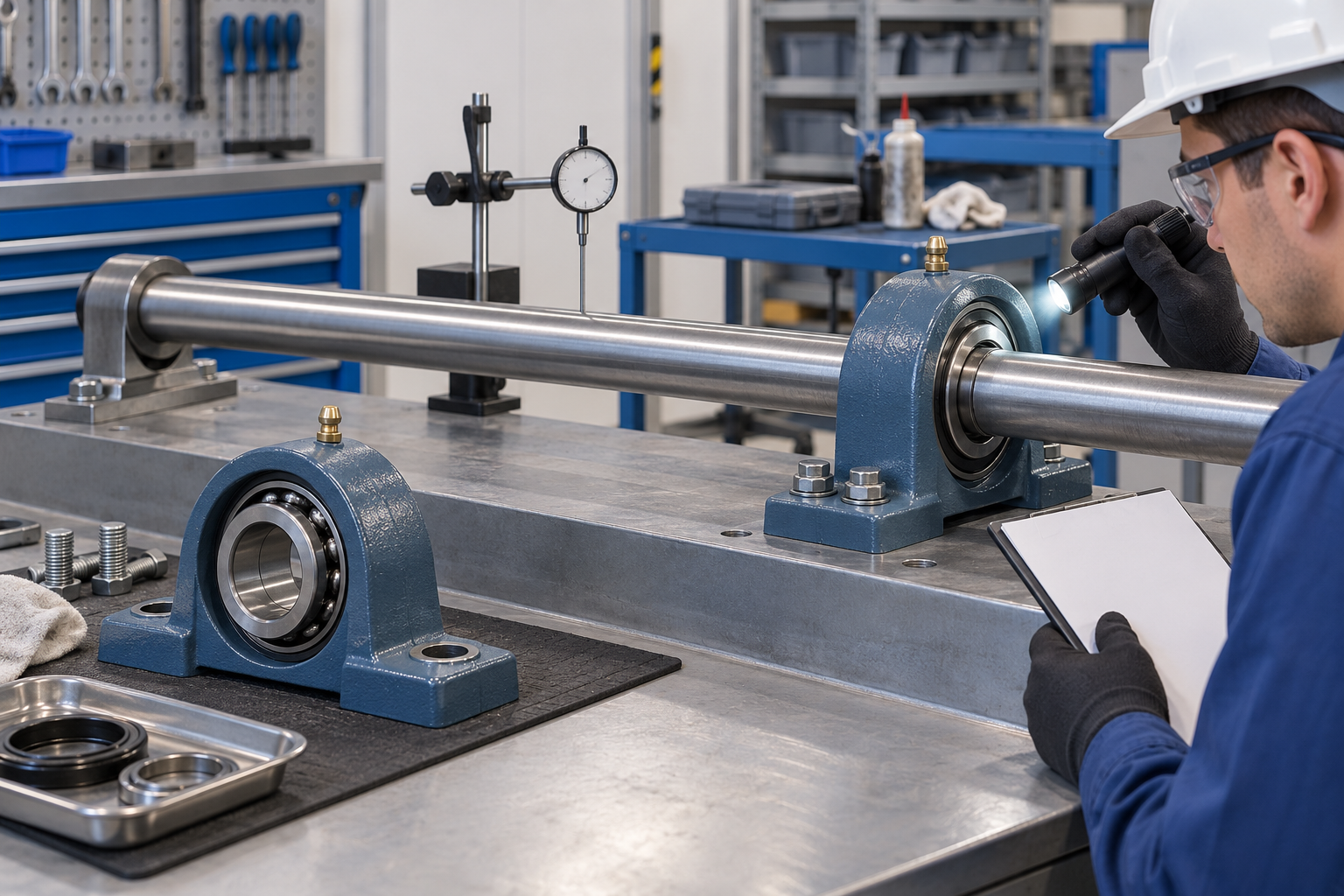
Find out why the first unit needs replacement
A bearing can be damaged by a local issue, such as a failed seal or incorrect installation, or by a condition that may affect more than one support—such as contamination, shaft misalignment, excessive belt tension, or a distorted mounting structure.
Before ordering parts, preserve the unit’s identification and document the symptoms and evidence. Note when noise, vibration, heat, leakage, or looseness appeared; whether the machine recently changed duty; and whether the shaft, housing, or mounting base shows visible damage. A symptom alone does not establish the root cause.
NSK’s maintenance guidance recommends checking bearing condition and operating factors during inspection and part replacement, and assessing whether damage is present before deciding whether a bearing can be reused. This supports an inspection-based decision, not a blanket pair-replacement rule. See the NSK Bearing Doctor maintenance guide.
Inspect the other support before deciding
If the machine procedure permits inspection, assess the companion unit and the full shaft line. Check for abnormal noise or roughness, looseness, lubricant leakage, seal damage, corrosion, movement on the shaft, and visible problems at the housing or base. Review alignment and mounting condition across all supports rather than looking only at the failed unit.
If disassembly is required, follow the equipment owner’s isolation and maintenance procedures. Do not return equipment to service based only on a visual check if the application is safety-critical or the damage is uncertain.
When replacing one unit may be appropriate
Replacing only the affected unit may be reasonable when the inspection identifies a localized problem, the other support is serviceable under the equipment’s criteria, the shaft and mounting arrangement are acceptable, and the equipment manufacturer’s instructions allow it.
Record what was replaced and why. Keeping that history makes later inspection and purchasing decisions easier to assess.
When to consider replacing or investigating both
Inspect both supports carefully when they share the same operating conditions or when the suspected cause could affect the whole shaft line. If both units show abnormal condition, if a common mounting or alignment issue is found, or if the equipment instructions call for replacement as a set, follow the applicable procedure.
Even when only one unit is replaced, correct the cause that contributed to its damage before restarting. Otherwise, a new bearing may encounter the same condition. The bearing failure documentation guide explains what to record before cleaning or disassembly.
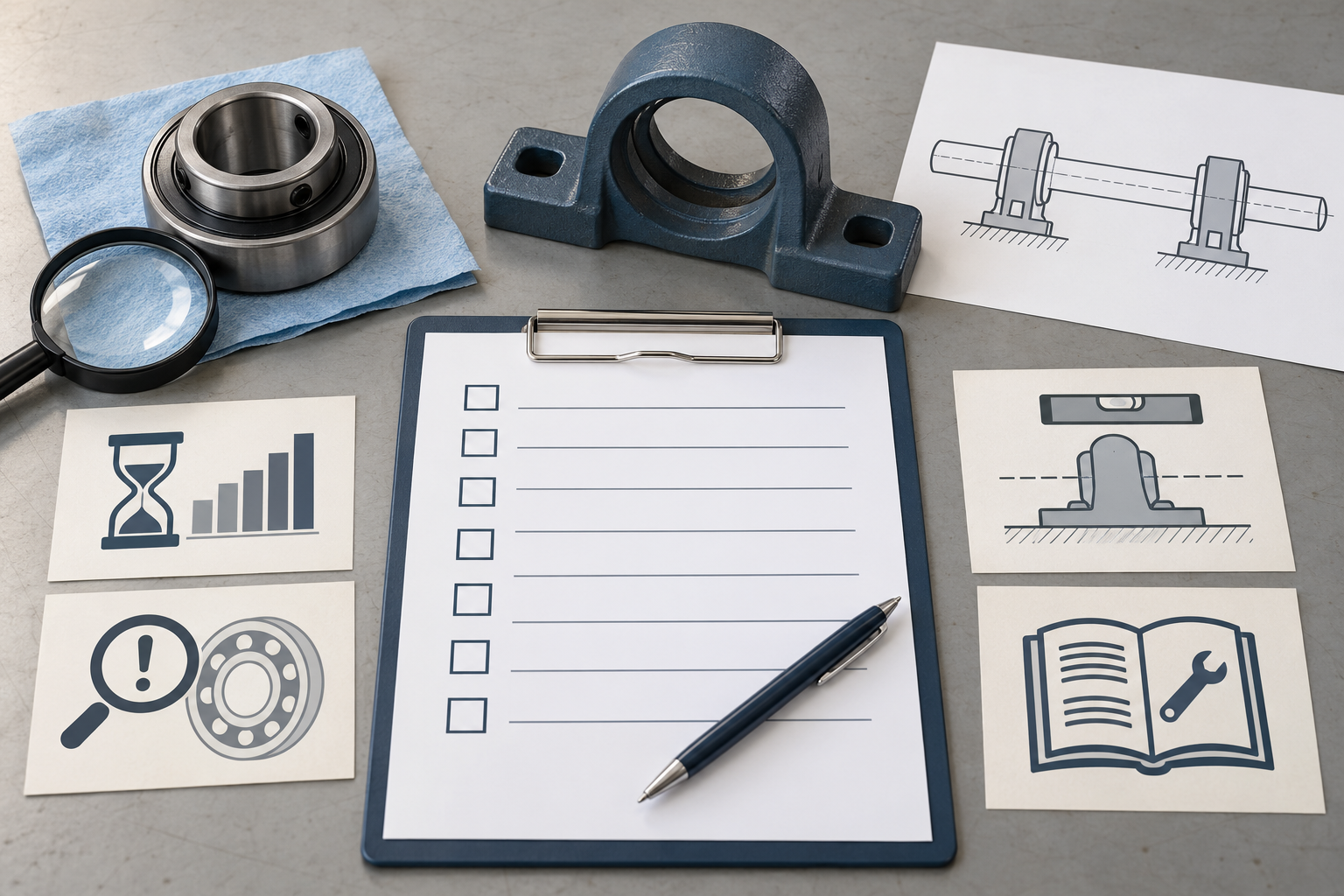
Information to collect before ordering
Prepare the complete bearing and housing designations, shaft diameter and units, the position of each support, symptoms and operating history, relevant photographs, and any available equipment drawing. State whether you are considering an insert-only replacement or a complete mounted unit. The pillow block replacement checklist covers the identification and mounting details to collect.
For installation and post-installation checks, consult the insert bearing installation guide. Product-specific drawings and equipment instructions take priority over general online guidance.
Conclusion
Do not replace both mounted bearings automatically just because they support the same shaft. Inspect the companion unit, investigate whether the failure cause is local or shared, check the shaft and mounting arrangement, and follow the machine manufacturer’s instructions. The right decision is the one supported by the equipment design and inspection evidence.
For a Cixi CTZ product or application inquiry, contact ctz@ctz-bearing.com or WeChat DM161116.
Same-shaft replacement review
- Confirm the complete unit design and equipment instructions.
- Document symptoms, history, and evidence before cleaning or disassembly.
- Inspect the companion support and the full shaft line where procedures permit.
- Check for common causes such as contamination, alignment, or mounting problems.
- State whether the request is for an insert only or a complete mounted unit.
Key Takeaways
- There is no blanket rule to replace every pair of mounted units together.
- Inspect the companion support and investigate whether the failure cause is local or shared.
- Follow equipment instructions and record the model, shaft, mounting, symptoms, and operating history.
Frequently Asked Questions
Should pillow block bearings on the same shaft always be replaced in pairs?
No universal pair-replacement rule applies to every installation. Follow equipment instructions and assess the second support’s condition and the cause of the first unit’s problem.
If one mounted bearing fails, can I replace only that unit?
Possibly, if inspection and equipment requirements support that decision. Confirm the failure cause and check the companion support, shaft, housing, and mounting condition.
Are two mounted bearings on a shaft the same as a matched bearing pair?
Not necessarily. Identify the bearing arrangement and product design before applying matched-set guidance.
What should I record before ordering a replacement?
Record the unit designations, shaft size and units, support positions, symptoms, operating history, mounting details, and photographs. Clarify whether you need an insert or a complete unit.
Need bearing units for your market?
Send us the model number, quantity, packing requirement and destination port. Our sales team will reply with a competitive quotation and delivery schedule.
Send Inquiry