Contents
- 1. Record the whole designation
- 2. Send dimensions with their units
- 3. Confirm how the bearing locks to the shaft
- 4. Decide whether to request an insert or a complete unit
- 5. Explain why the old unit is being replaced
- 6. Ask for a written compatibility check
- Technical references
- Frequently Asked Questions
The old bearing number is readable, and the replacement looks similar. Is that enough to place an order?
Treat it as a starting point. Before buying, ask the supplier to confirm the exact replacement against the information from your machine. A clear enquiry is easier to check than a message that says only “please quote an equivalent.”
This checklist is for buyers preparing a replacement order. It is not a removal procedure: any inspection that requires access to machinery should follow the equipment owner's isolation and maintenance procedures.
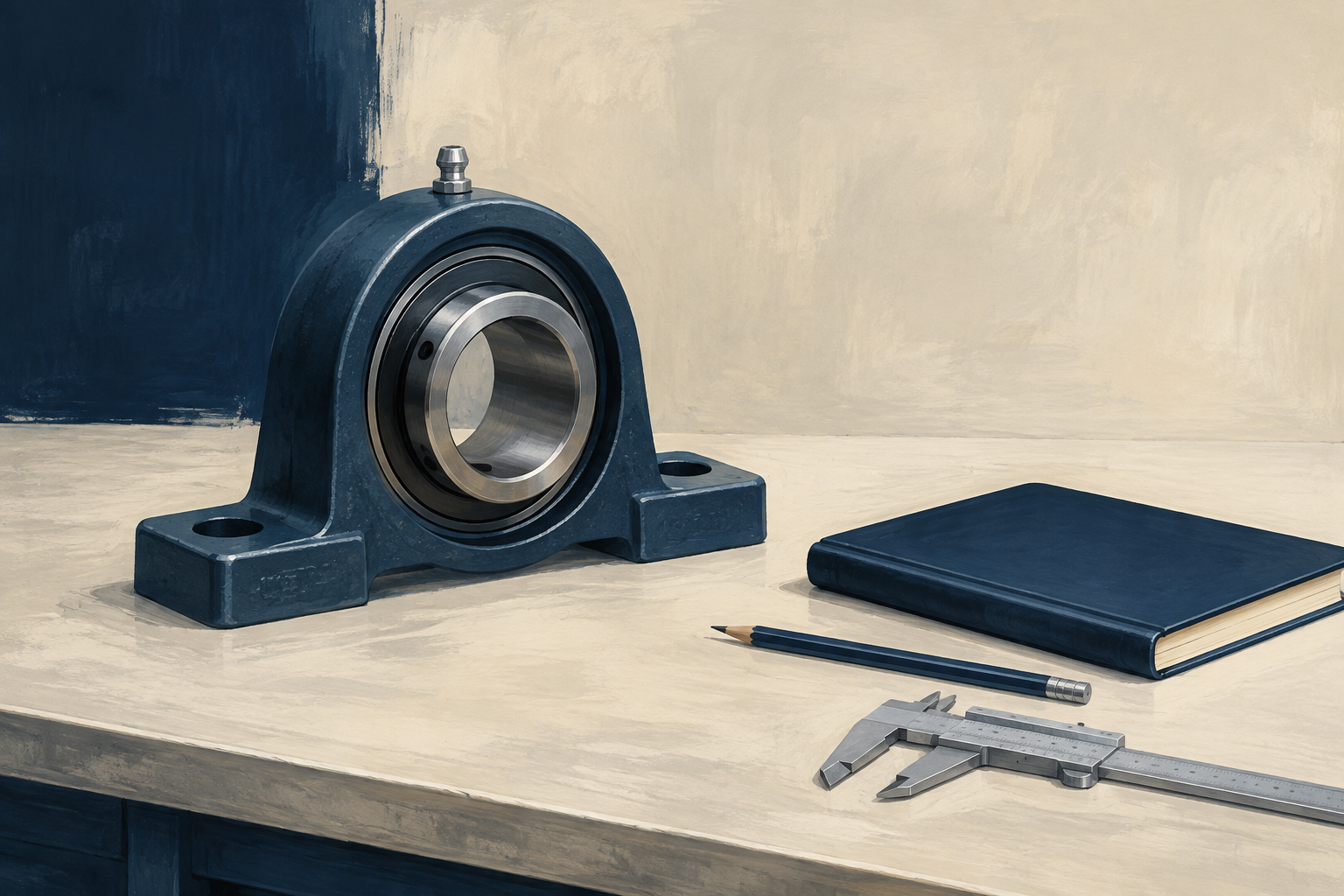
1. Record the whole designation
Photograph the markings on both the bearing insert and the housing. Include every visible prefix, suffix and bore-size code. Keep the original photos, even if you also type the reference into your enquiry.
If a character is unclear, mark it as unreadable. Guessing a letter or leaving out a suffix makes the enquiry look more certain than it is.
Also state what you want to buy: the insert alone or the complete mounted unit. These are different purchasing requests. The insert bearing overview explains the distinction.
2. Send dimensions with their units
For a pillow block replacement, collect the shaft diameter, mounting-hole spacing and shaft centre height above the mounting surface. Compare these with the proposed unit's drawing. Check the mounting slots and available envelope as well; bore size alone does not describe the mounting arrangement. SKF's unit catalogue separates bearing and housing dimensions for this reason.[1]
Do not round a measurement into a model number
Record whether a measurement is in millimetres or inches. If a reading is approximate, say so. A rough measurement can help identify a candidate, but it is not a substitute for a confirmed drawing.
For the enquiry, a small table keeps the evidence together:
| Item | Information to send |
|---|---|
| Existing identification | Full markings and clear photographs |
| Shaft | Measured diameter, units and any uncertainty |
| Mounting | Hole spacing, centre height and mounting-surface photo |
| Space | Nearby guards, pulleys or other restrictions |
| Reference | Existing drawing or equipment spare-parts reference |
Use the UCP product page to identify the relevant product family, then request the drawing for the specific proposed unit.
3. Confirm how the bearing locks to the shaft
Identify the locking arrangement rather than assuming that two similar-looking units attach in the same way. Set screws, eccentric collars and adapter arrangements are examples documented in manufacturers' literature.[1]
Photograph the locking side and note whether access is restricted. NTN's discussion of mounted-unit set screws also illustrates why locking details deserve attention; its product-specific features must not be assumed to apply to another manufacturer's unit.[2]
Ask for the installation instructions for the actual replacement. Do not carry a tightening value from a different product into the new order.
4. Decide whether to request an insert or a complete unit
If you hope to retain the housing, make that explicit and ask for insert-to-housing compatibility to be checked. Send the housing reference and condition photos. Do not describe a housing as reusable solely because it looks intact from one side.
A useful enquiry can request two clearly separated options: an insert, subject to compatibility and condition confirmation, and a complete mounted unit. This lets your maintenance team compare the options without confusing their scope.
5. Explain why the old unit is being replaced
Was the replacement planned, or did the machine develop noise, heat or vibration? What was observed, and when? Keep observations separate from a diagnosis.
For example, “noise increased after the cleaning routine changed” is useful information. “The seal failed” is a conclusion that may still need investigation. Share any inspection notes with the supplier and the person responsible for maintaining the machine.
Include operating speed if known, loading information, dust or water exposure, cleaning method and lubrication practice. Do not fill gaps with guessed figures. The existing contamination guide can help organize the environmental details.
6. Ask for a written compatibility check
Before approving an alternative, request its full designation and drawing, plus an explanation of any differences from the old unit. A cross-reference is useful evidence, but clarify exactly what has been compared.
Here is a short enquiry you can adapt:
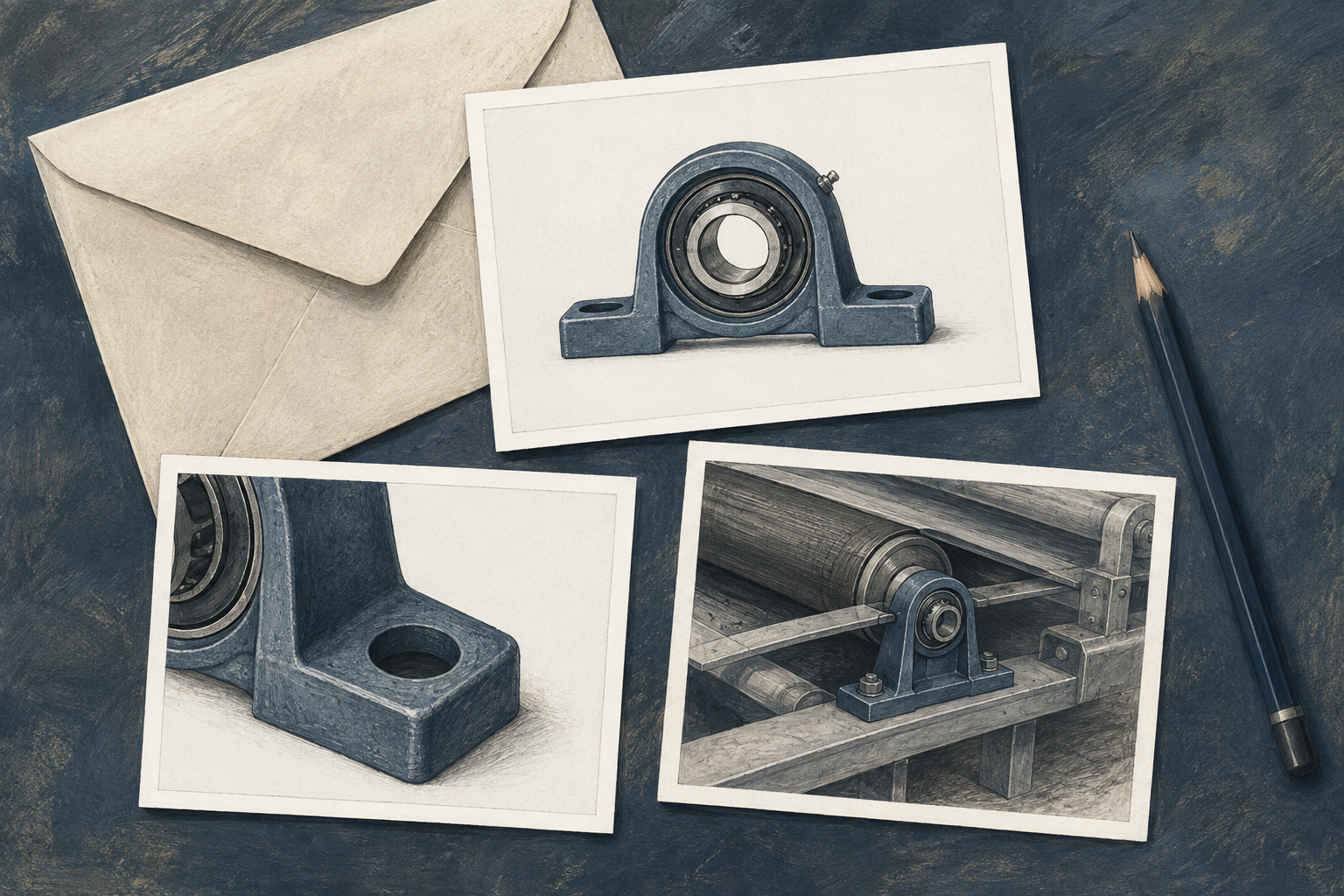
Please review a replacement for the attached mounted bearing unit. The existing markings and measured dimensions are included. We require [insert only / complete unit], quantity [quantity]. Please confirm the proposed designation, drawing, locking arrangement and any differences we should review. Unknown operating details are marked as unknown.
For a Cixi CTZ enquiry, send this information through the contact page or email ctz@ctz-bearing.com. A drawing, readable markings and a few well-chosen photos give the discussion a much firmer starting point.
Technical references
[1] SKF Y-bearings and Y-bearing units catalogue. Generic arrangements and dimensions; not a Cixi CTZ interchange guarantee.
[2] NTN: Ball Point Set Screws for NTN Ball Bearing Mounted Units. NTN-specific features and performance are not attributed to Cixi CTZ.
Key Takeaways
- Record the full markings and measured dimensions, including units.
- Confirm the locking arrangement and whether the order is for an insert or complete unit.
- Request a drawing and written review of differences before approving an alternative.
Frequently Asked Questions
Is the same bore size enough to confirm a replacement?
No. Check mounting dimensions and the locking arrangement as well, then review suitability for the operating conditions against the proposed product documentation.[1]
Can I order only the insert bearing?
You can request an insert-only option, but identify the retained housing and have compatibility and housing condition checked before approval. State clearly that your request excludes the housing.
What if the old marking cannot be read?
Send clear photos, measurements with units, and the equipment reference or drawing if available. Keep uncertain details labelled as uncertain rather than guessing a model.
Which photos should accompany the enquiry?
A practical set shows the full unit, its markings, the locking side and its mounting location. Take these only when access is safe under your equipment procedures.
Need bearing units for your market?
Send us the model number, quantity, packing requirement and destination port. Our sales team will reply with a competitive quotation and delivery schedule.
Send Inquiry