Contents
- Why Orientation Changes the Review
- A Vertical-Shaft Application Checklist
- Identify Every Load and Its Direction
- Confirm How the Shaft Is Retained
- Check the Housing and Support Structure
- Review Lubrication and Sealing for the Actual Orientation
- Confirm Alignment, Shaft Fit, and Installation Access
- What to Send for a Technical Review
- Key Takeaways
- Frequently Asked Questions
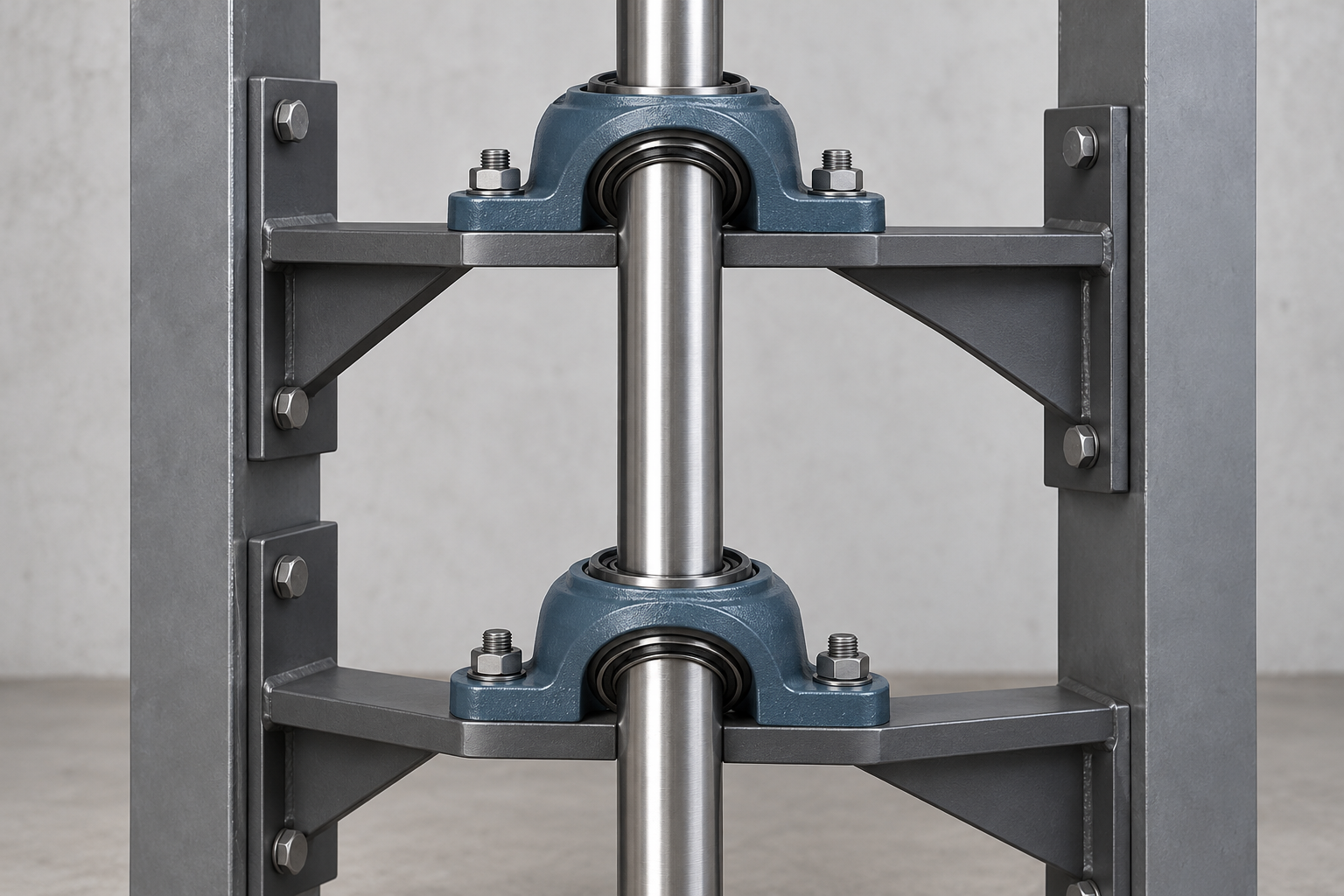
A mounted bearing unit that works on a horizontal shaft is not automatically suitable for the same machine turned upright. With a vertical shaft, gravity and process forces act in a different relationship to the bearing, housing, locking arrangement, and support plate. Pumps, mixers, fans, and vertical conveyors can also impose forces beyond the weight of the shaft or rotor.
The safe starting point is to review the complete arrangement—not select a unit from its bore or housing shape alone. Some bearing-unit product families specifically call for modified construction, seals, or lubrication in vertical-shaft applications. That is not a universal statement about every UCP, UCF, UCFL, or UCT unit; requirements depend on the exact product and machine. Confirm them with the equipment designer and bearing manufacturer before purchase.
Why Orientation Changes the Review
In a horizontal arrangement, a common load may act toward the base of an upright pillow block. On a vertical shaft, the bearing may experience axial force parallel to the shaft in addition to radial force. The load path also passes through the inner-ring locking feature, housing, fasteners, support plate, and machine structure.
The bearing’s radial load rating is not, by itself, proof that the complete unit can carry the application’s thrust or remain securely located on the shaft. The limiting factor may be the rolling bearing, the locking method, the housing, the mounting bolts, or the support structure. Assess actual load components and direction for the selected product and orientation. For the general distinction between radial force, axial force, and shaft-holding capability, see the Radial vs Axial Loads in Mounted Bearing Units guide.
A Vertical-Shaft Application Checklist
1. Identify Every Load and Its Direction
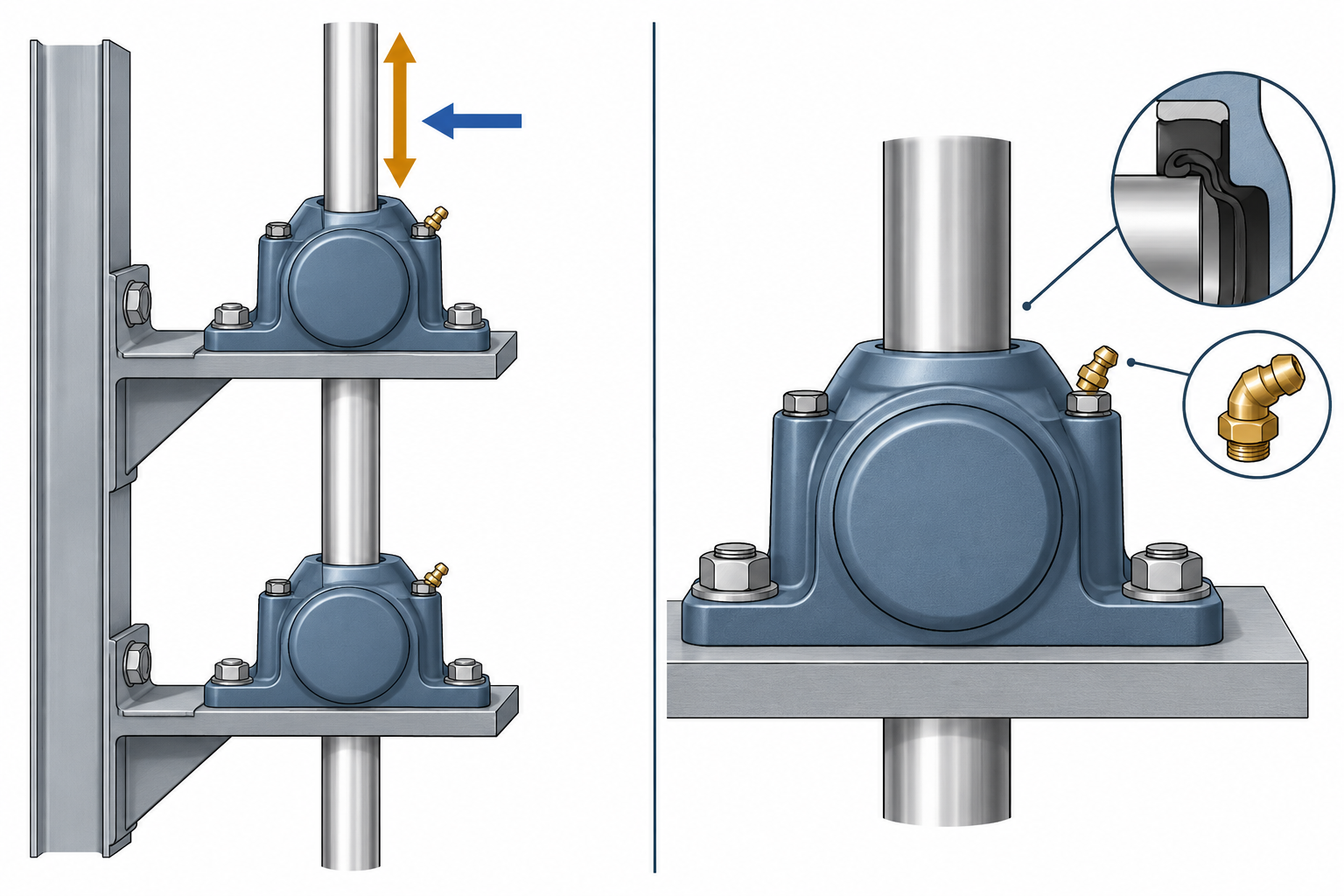
Record shaft and rotor weight, radial forces from belts or couplings, process forces, thrust from an impeller or screw, start-stop or shock conditions, and any forces that change direction. Where values are not known, mark them as unknown rather than estimating. The equipment designer should calculate bearing reactions from machine geometry and operating cases.
2. Confirm How the Shaft Is Retained
Determine how the inner ring is locked to the shaft and whether the arrangement must resist axial movement. A set screw, eccentric collar, adapter sleeve, shoulder, or other retention detail has product-specific limits and installation requirements. Do not assume a shaft-locking feature can carry unlimited thrust or that a bearing’s internal axial capacity also confirms shaft retention.
3. Check the Housing and Support Structure
Confirm the exact housing style, mounting orientation, bolt pattern, support-plate thickness and rigidity, and fastener requirements. The housing must be supported in the direction of the applied forces without unacceptable distortion. Do not transfer a catalog rating for one mounting orientation to another without confirmation.
4. Review Lubrication and Sealing for the Actual Orientation
Ask whether the exact unit is intended for the proposed vertical direction, speed, temperature, contamination, and maintenance schedule. Check how shaft position and gravity may affect grease distribution, lubricant retention, and seal exposure. Do not add grease or change a seal arrangement based only on a generic vertical-shaft rule.
5. Confirm Alignment, Shaft Fit, and Installation Access
Check shaft size and surface condition, alignment of multiple supports, access to locking hardware and grease fittings, and how the unit can be installed or removed. A self-aligning insert accommodates only the limited misalignment intended by its design; it does not correct a bent shaft or weak support. See the mounted-bearing self-alignment guide and insert-bearing installation guide for those separate topics.
What to Send for a Technical Review
| Application detail | Information to provide |
|---|---|
| Bearing and housing | Full designation or proposed unit, if known |
| Shaft | Diameter, material, shoulder arrangement, and drawing |
| Layout | Support spacing, shaft orientation, and mounting surfaces |
| Operating loads | Radial and axial loads, directions, speed, duty, shock, and reversing conditions |
| Installation | Locking method, fasteners, lubrication plan, seals, and environment |
| Evidence | Photos of the current arrangement and failed components, if applicable |
The manufacturer can review the unit configuration, while the machine designer remains responsible for validating the shaft, structure, loads, and safe machine operation. Contact Cixi CTZ at ctz@ctz-bearing.com or WeChat: DM161116.
Key Takeaways
| Selection check | Why it matters |
|---|---|
| Load direction and complete load path | Vertical orientation changes how forces act through the bearing, lock, housing, fasteners, and support. |
| Bearing capacity and shaft retention | These are separate questions and either may limit the application. |
| Housing support, seals, lubrication, and access | Confirm each for the exact product, orientation, and operating environment. |
| Product-specific guidance | Do not assume every standard mounted unit suits every vertical-shaft application or infer suitability from bore size alone. |
Frequently Asked Questions
Can I use a standard UCP bearing unit on a vertical shaft?
Do not assume suitability from the UCP designation alone. Confirm the exact unit’s permitted orientation, load direction, shaft retention, housing support, lubrication, and sealing requirements with the equipment designer and supplier.
Does a vertical shaft add axial load to the bearing?
It can. Shaft and rotor weight, process forces, and other machine elements may create thrust parallel to the shaft. Actual loads and bearing reactions depend on the machine design and must be determined for that application.
Is the bearing’s radial load rating enough to select a vertical-shaft unit?
No. The bearing, locking method, housing, fasteners, and support plate may have different limits. Review the complete load path and product documentation.
Do vertical mounted bearings always need different grease or seals?
Not as a universal rule. Requirements depend on the specific bearing construction, orientation, speed, temperature, and environment. Follow exact product guidance rather than changing grease or seals generically.
What information should I provide when asking about a vertical-shaft bearing?
Provide the model or proposed unit, a dimensioned layout, shaft and support details, radial and axial loads, speed, duty cycle, environment, retention method, lubrication plan, and photos or drawings where available.
Technical References
SKF Cooper, Flange-Mounted Units; NSK, Mounted Units; NTN Americas, Bearing Units Handbook. These sources were consulted for general product-specific orientation and installation guidance; their requirements are not assumed to apply identically to every manufacturer.
Key Takeaways
- Vertical orientation changes load direction and the complete unit’s load path.
- Review bearing capacity and shaft retention as separate questions.
- Confirm housing support, fasteners, seals, lubrication, installation access, and orientation for the exact product.
- Do not assume every standard mounted unit is suitable for every vertical-shaft application.
- Use application drawings and manufacturer guidance; do not infer suitability from bore size alone.
Frequently Asked Questions
Can I use a standard UCP bearing unit on a vertical shaft?
Do not assume suitability from the UCP designation alone. Confirm the exact unit’s permitted orientation, load direction, shaft retention, housing support, lubrication, and sealing requirements with the equipment designer and supplier.
Does a vertical shaft add axial load to the bearing?
It can. Shaft and rotor weight, process forces, and other machine elements may create thrust parallel to the shaft. Actual loads and bearing reactions depend on the machine design and must be determined for that application.
Is the bearing’s radial load rating enough to select a vertical-shaft unit?
No. The bearing, locking method, housing, fasteners, and support plate may have different limits. Review the complete load path and product documentation.
Do vertical mounted bearings always need different grease or seals?
Not as a universal rule. Requirements depend on the specific bearing construction, orientation, speed, temperature, and environment. Follow exact product guidance rather than changing grease or seals generically.
What information should I provide when asking about a vertical-shaft bearing?
Provide the model or proposed unit, a dimensioned layout, shaft and support details, radial and axial loads, speed, duty cycle, environment, retention method, lubrication plan, and photos or drawings where available.
Need bearing units for your market?
Send us the model number, quantity, packing requirement and destination port. Our sales team will reply with a competitive quotation and delivery schedule.
Send Inquiry