Contents
- How the Self-Aligning Interface Works
- Initial Misalignment and Operational Misalignment Are Different
- What Self-Alignment May Help Accommodate
- What Self-Alignment Cannot Correct
- Why Two Units on One Shaft Still Need Alignment
- Warning Signs After Installation
- Questions to Ask Before Ordering
- Technical references
- Frequently Asked Questions
“Self-aligning” can sound as if a mounted bearing unit will correct any shaft or installation error by itself. That is not what the feature means.
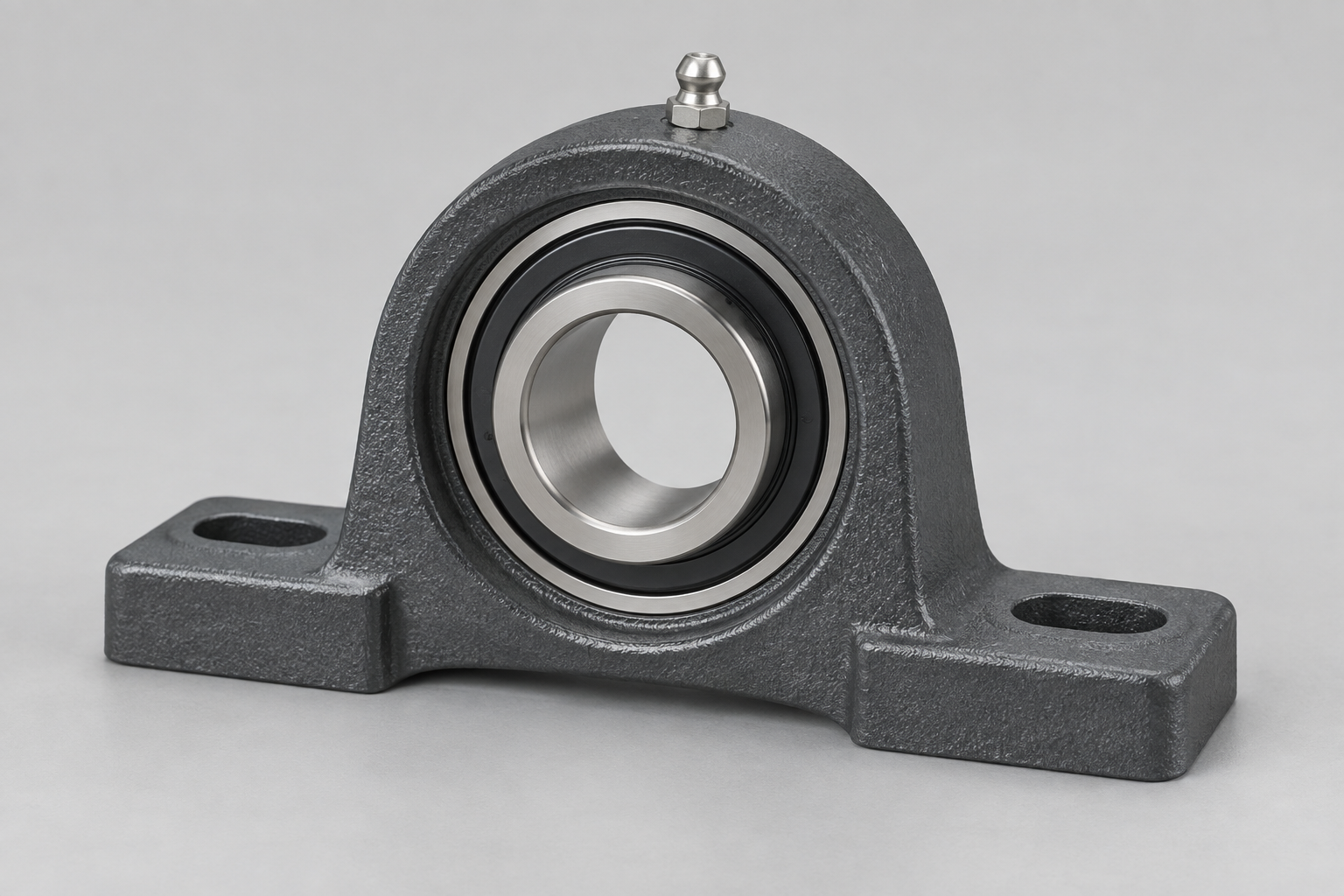
In many insert-bearing units, the outside surface of the bearing and the mating bore in the housing are spherical. This interface lets the insert settle at a small angle relative to the housing during installation. NTN describes this spherical fit as the feature that allows its bearing units to compensate for misalignment.[1]
The feature is useful, but it has limits. It does not make a bent shaft straight, bring two incorrectly positioned housings onto one centreline or repair an uneven mounting base. Understanding that distinction helps buyers and maintenance teams avoid treating self-alignment as a substitute for correct machine alignment.
How the Self-Aligning Interface Works
A mounted ball bearing unit combines an insert bearing with a housing. The insert supports and locks to the shaft. Its convex spherical outside surface sits in a matching concave housing bore. NTN’s bearing-unit catalogue identifies both surfaces as spherical and describes the resulting unit as self-aligning.[1]
This movement takes place between the insert and housing. It is not the same mechanism as a double-row self-aligning ball bearing or spherical roller bearing correcting angular displacement inside its raceways. The products should not be treated as interchangeable simply because they share the words “self-aligning.”
The UC insert-bearing page shows the type of spherical-outer insert used inside several common mounted-unit housings. For an actual order, check the proposed insert, housing and manufacturer’s documentation together.
Initial Misalignment and Operational Misalignment Are Different
Manufacturer literature often distinguishes static or initial misalignment from dynamic misalignment.
Initial or static misalignment
Initial misalignment exists when the housing mounting face and the shaft or insert axis are not perfectly square during assembly. The spherical seating interface may allow the insert to settle within the housing and accommodate a limited initial angular difference.
SKF explains this distinction for its Food Line ball bearing units: the spherical outer ring and housing bore can accommodate some static misalignment caused by mounting error.[2] The allowable value in that guide varies with the particular housing and seal configuration. It should not be applied to another product family without confirmation.
Operational or dynamic misalignment
Operational misalignment develops or changes while the shaft rotates. Possible contributors include shaft bending under load, movement of the supporting structure, different centre positions between bearings or changing thermal and process conditions.
The same SKF guide treats dynamic misalignment much more restrictively than initial seating error.[2] The practical lesson is not to copy its numerical limit into another product specification, but to recognize that a unit’s initial self-seating ability does not automatically authorize continuing shaft movement or deflection during operation.
What Self-Alignment May Help Accommodate
Subject to the limits for the exact unit, spherical seating may help with a small initial angular difference between:
| Initial condition | What still requires confirmation |
|---|---|
| Insert-bearing axis and housing mounting orientation | Allowable angle for the exact insert and housing |
| Machined mounting face and shaft during assembly | Mounting accuracy and structural condition |
| Face-mounted housing and the shaft passing through it | Drawing, seals and surrounding clearances |
| Base-mounted housing and a minor initial mounting-angle error | Product instructions and application load |
This feature can make installation more tolerant than a rigid insert-to-housing fit. It is still necessary to follow the product instructions and confirm the allowable alignment for the exact unit, seal arrangement and application.
Do not describe an unspecified Cixi CTZ unit with an angle taken from another manufacturer’s catalogue. If an allowable value is important to the design, request the model-specific drawing or technical confirmation.
What Self-Alignment Cannot Correct
A bent or damaged shaft
If the shaft is bent, worn, burred or outside the required diameter, the problem remains at the shaft-to-bearing interface. Timken’s ball-bearing housed-unit installation guidance calls for a clean, straight shaft of the proper diameter and warns against mounting on a worn shaft section.[3]
Two bearing units on different centrelines
When two housings support one shaft, their positions must allow the shaft to pass through without being forced. Self-seating at each housing does not guarantee that two incorrectly located supports form a correct shaft line.
An uneven, warped or weak mounting surface
A housing bolted across a distorted base may be twisted or loaded unevenly. The insert’s spherical seating does not flatten the base or restore structural rigidity. Inspect the mounting pads and use only an engineering-approved correction.
Incorrect shaft fit or locking
The spherical outer surface acts between the insert and housing; it does not correct an unsuitable shaft diameter, damaged locking device or incorrect tightening procedure. Confirm the locking method and follow the instructions for the actual model.
Excessive movement during operation
Repeated or changing angular movement can affect the spherical seating interface, seals, lubricant path and load distribution. NTN notes that looseness, vibration and impact can accelerate wear of the spherical surface in its units.[4] A unit that repeatedly changes position in the housing requires investigation rather than an assumption that it is “self-aligning normally.”
Why Two Units on One Shaft Still Need Alignment
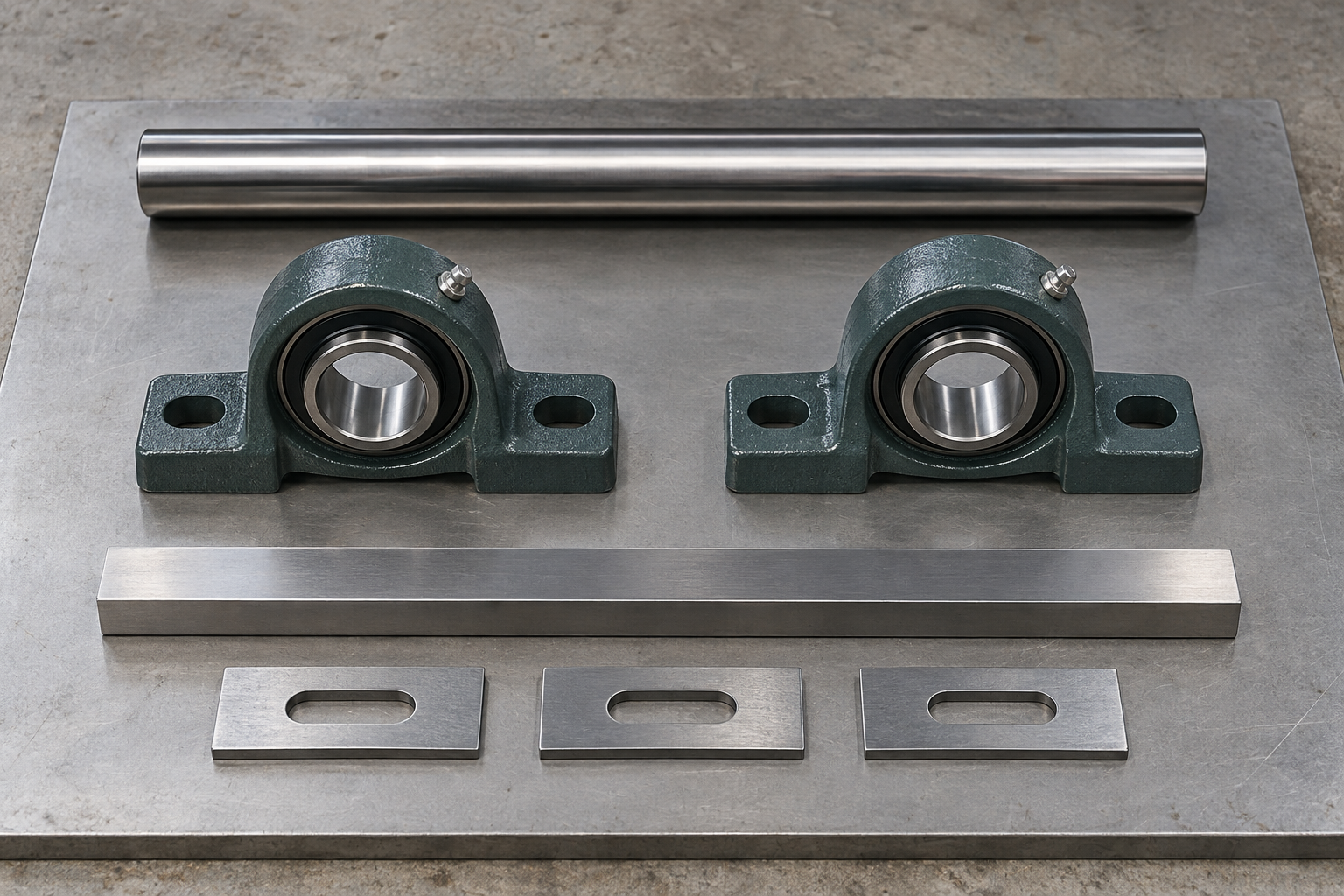
With two mounted units, the shaft, housing locations and mounting planes form one system. A small seating adjustment inside each housing does not remove the need to position the supports correctly.
| Check | General purpose |
|---|---|
| Shaft condition | Confirm that the shaft is straight, clean and within the required dimensional condition |
| Mounting surfaces | Inspect both surfaces for damage, debris and uneven contact |
| Housing position | Position without using mounting bolts to force the shaft into line |
| Rotation | Check for abnormal resistance where the manufacturer’s procedure permits hand rotation |
| Fastening | Use the specified sequence and values for mounting and locking fasteners |
| Commissioning | Recheck rotation, temperature, noise and vibration under the equipment owner’s procedure |
Timken similarly instructs installers to align a ball-bearing housed unit in its housing, use a proper shaft and bolt the housing securely to its support.[3] Product-specific procedures and safety controls take precedence over this general checklist.
Warning Signs After Installation
After commissioning, investigate rather than dismiss symptoms such as unusual rotational resistance, a temperature difference between units, repeated insert movement, loose fasteners, abnormal noise or vibration, seal disturbance, lubricant leakage, or fretting and wear marks.
These observations do not prove a single root cause. They can also be associated with lubrication, contamination, load, shaft fit or component damage. The bearing noise, vibration and overheating guide and pillow block bearing failure guide provide broader troubleshooting checklists.
If safe inspection requires removing a guard or approaching machinery, follow the equipment owner’s isolation and maintenance procedure before access.
Questions to Ask Before Ordering
For a new unit or replacement, provide the supplier with enough information to distinguish a manageable initial alignment condition from a larger machine-design issue:
| Information | What to provide |
|---|---|
| Unit identification | Full model, housing type and suffix |
| Shaft | Diameter, condition, length between supports and drawing if available |
| Arrangement | Number of bearing units and which positions locate or allow movement |
| Mounting | Base or face geometry, bolt pattern and photographs |
| Operation | Speed, load direction, duty cycle and known shaft deflection |
| Environment | Dust, moisture, temperature, cleaning and lubrication conditions |
| Current symptom | What was observed and when, without guessing the cause |
If the application requires a defined allowable angle, dynamic movement or shaft-deflection capability, request a written check for the exact model. Use the contact page or email ctz@ctz-bearing.com to send Cixi CTZ the model, quantity, application information and available drawings.
Technical references
[1] NTN, Bearing Units catalogue. Used to verify the spherical outer bearing surface, spherical housing bore and general self-aligning interface.
[2] SKF, Food Line Ball Bearing Units — Alignment. Used to distinguish static mounting misalignment from dynamic operational misalignment. Product-specific angle values are deliberately not transferred to Cixi CTZ products.
[3] Timken, Ball Bearing Housed Units catalogue. Used for generic installation checks covering shaft condition, alignment and secure housing mounting. No Timken specification is attributed to Cixi CTZ.
[4] NTN, Features of NTN Bearing Units. Used to verify the spherical fit and the warning that looseness, vibration and impact can wear the spherical surface. NTN-specific design claims are not attributed to Cixi CTZ.
Key Takeaways
- Self-alignment describes limited movement between a spherical-outer insert and its housing, not automatic correction of every machine error.
- Initial mounting misalignment and changing operational misalignment must be treated as different conditions.
- A straight shaft, correctly positioned supports, suitable mounting surfaces and model-specific limits still matter.
Frequently Asked Questions
Why are mounted bearing units described as self-aligning?
Many units use an insert with a convex spherical outside surface seated in a matching spherical housing bore. This interface can let the insert settle at a limited angle relative to the housing.
Does a self-aligning pillow block fix a bent shaft?
No. The seating feature does not straighten the shaft or correct an unsuitable shaft surface. The shaft should meet the dimensional and condition requirements for the selected unit.
Can self-alignment compensate for two housings mounted at different heights?
Do not assume that it can. Two supports on one shaft still need a correctly established centreline and mounting planes. Any offset should be assessed against the equipment design and the exact unit limits.
What is the difference between static and dynamic misalignment?
Static misalignment is an initial angular difference present during mounting. Dynamic misalignment changes during operation, for example with shaft deflection or support movement. Manufacturer guidance may allow very different limits for the two conditions.
Is there one standard allowable misalignment angle for every mounted unit?
No. Allowable values depend on the unit design, housing, seals and operating conditions. Use the documentation for the exact product instead of transferring a number from another brand or series.
Need bearing units for your market?
Send us the model number, quantity, packing requirement and destination port. Our sales team will reply with a competitive quotation and delivery schedule.
Send Inquiry