Contents
- What Do UCF and UCFL Mean?
- The Main Difference Is the Mounting Interface
- Compare the Mounting Footprint Before the Bore
- Can UCF and UCFL Use the Same Insert Bearing?
- Choosing for a New Machine Design
- Replacing an Existing Flange Bearing Unit
- Information to Send with a UCF or UCFL Enquiry
- Technical references
- Frequently Asked Questions
UCF and UCFL units can carry the same UC insert-bearing size, yet they do not mount to a machine in the same way. UCF uses a square four-bolt flange housing. UCFL uses an oval two-bolt flange housing. That difference changes the mounting footprint, bolt pattern and space required around the shaft.
For a new machine, the available mounting face often points toward one format. For a replacement, the existing bolt pattern and shaft position usually matter more than the general appearance. This guide explains what to compare before requesting a quotation; final selection should be checked against the drawing and operating data for the specific unit.
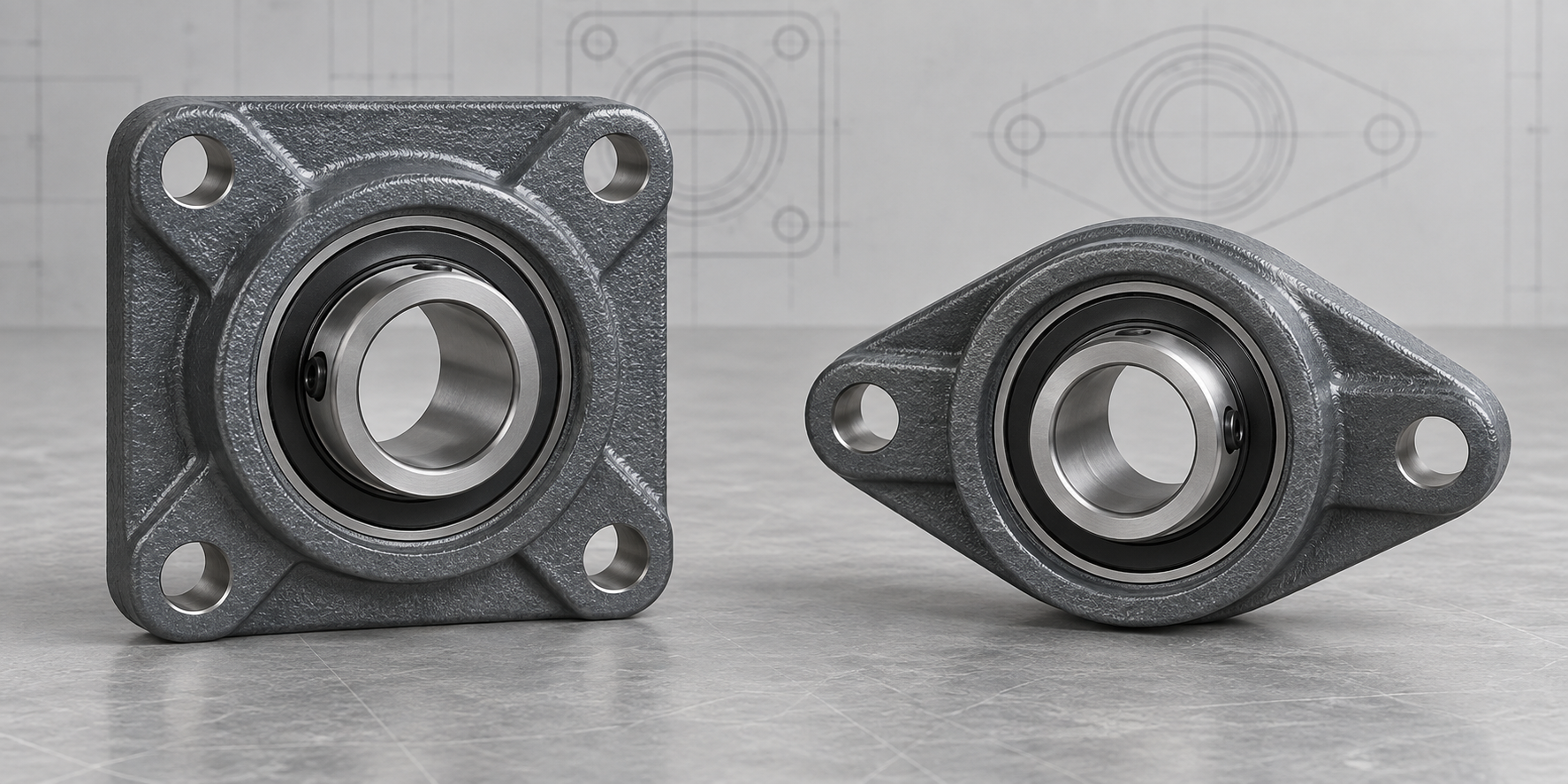
What Do UCF and UCFL Mean?
In common mounted-unit designations, “UC” identifies the insert-bearing family, while the following housing code identifies the unit form. SKF’s UC-range designation guide lists F as a square four-bolt flange and FL as an oval two-bolt flange.[1] NTN and NSK catalogues also list square UCF and rhombus or oval UCFL unit families separately.[2][3]
The basic distinction is therefore straightforward:
| Unit | General housing form | Mounting holes | Typical reason to consider it |
|---|---|---|---|
| UCF | Square flange | Four | A broad mounting face already has, or can accept, a square four-hole pattern |
| UCFL | Oval or rhombus flange | Two | The mounting face is narrow or a two-hole pattern is already present |
The Cixi CTZ UCF series page and UCFL series page show the two product families and their model-specific data.
The Main Difference Is the Mounting Interface
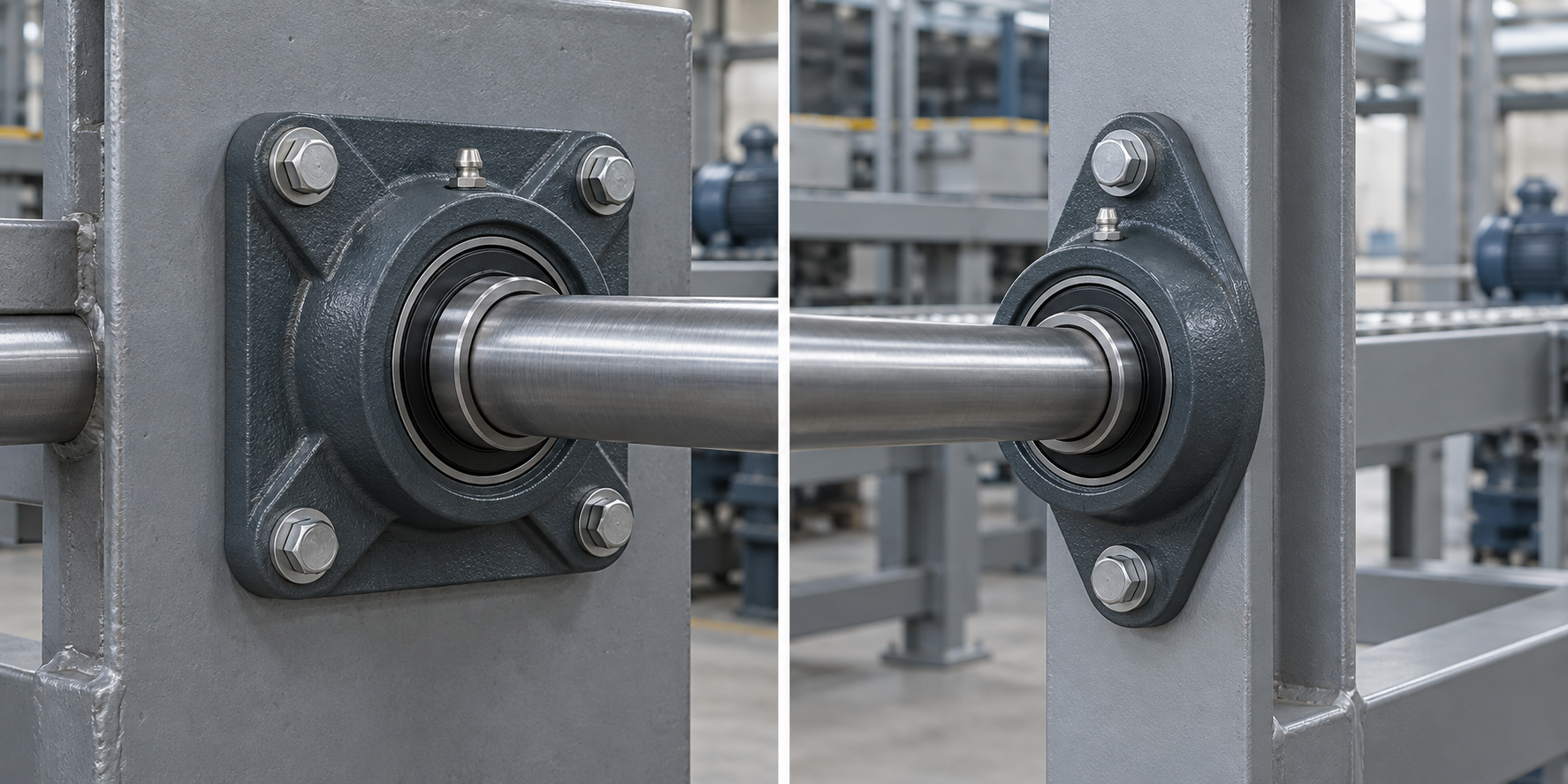
Both formats support a shaft through a face-mounted housing, but their attachment points are arranged differently. A UCF housing places four bolt holes around the bearing centre. A UCFL housing extends in two opposite directions and uses one bolt at each end.
This makes the available machine plate an important selection input. A broad square area may accommodate UCF. A narrow frame member may suit the slimmer UCFL outline. However, “fits in the available space” is only an initial screen. The machine designer must still check the plate, fasteners, load path and required rigidity.
Do not treat fewer bolts as a complete load rating
It is tempting to describe every four-bolt unit as heavy duty and every two-bolt unit as light duty. That shortcut is unreliable. Capacity and suitability depend on the complete unit: insert-bearing series, housing design, material, fasteners, mounting structure, load direction, speed and operating conditions.
Compare the published ratings and drawing for the exact proposed models. Bolt count alone does not prove that one unspecified unit can carry more load than another.
Compare the Mounting Footprint Before the Bore
Shaft diameter is essential, but it is not enough to establish interchangeability. For a replacement, record the existing mounting geometry before choosing a candidate.
Check at least:
| Check | What to record |
|---|---|
| Shaft | Diameter and whether it is metric or inch |
| Bolt pattern | Centre-to-centre distance between mounting holes |
| Fastener opening | Hole or slot size |
| Housing envelope | Overall housing width and height |
| Axial position | Relevant distance from the mounting face |
| Clearance | Space for bolt heads, tools, guards and nearby components |
| Maintenance access | Grease-fitting orientation and inspection access |
Use the symbols and reference surfaces shown on the supplier’s drawing rather than assuming that the same letter means the same dimension in every catalogue. NSK’s square- and oval-flange pages, for example, present separate dimensional tables for the two housing forms.[3][4]
Can UCF and UCFL Use the Same Insert Bearing?
Models in the same bore group may be built around the same UC insert designation. For example, UCF205 and UCFL205 commonly refer to units using a UC205-family insert. The UC insert-bearing overview explains how the insert forms the bearing element inside several mounted-unit housings.
That shared insert reference does not make the complete units interchangeable. The housings have different outlines and bolt patterns. Even when the bore matches, replacing UCF with UCFL—or the reverse—may require a different machine plate or adapter arrangement. Any structural modification should be reviewed by the equipment owner or designer.
If the existing application is base-mounted rather than face-mounted, start with the broader pillow block vs flange bearing guide before comparing UCF and UCFL.
Choosing for a New Machine Design
For a new design, begin with the machine structure rather than selecting a unit from appearance alone.
Choose a UCF candidate when
| UCF layout check | Requirement |
|---|---|
| Mounting face | The shaft passes through a broad, rigid mounting face |
| Bolt pattern | A square four-hole pattern is compatible with the structure |
| Access | There is room to install and inspect four fasteners |
| Final verification | The specific unit’s dimensions and ratings satisfy the design requirements |
Choose a UCFL candidate when
| UCFL layout check | Requirement |
|---|---|
| Mounting face | The shaft passes through a narrow frame or limited-width plate |
| Bolt pattern | A two-hole pattern is preferred or already designed into the structure |
| Clearance | The oval outline improves clearance around adjacent components |
| Final verification | The specific unit’s dimensions and ratings satisfy the design requirements |
These are layout considerations, not universal performance rules. Review loading, speed, shaft fit, sealing, lubrication, temperature and contamination for the actual application.
Replacing an Existing Flange Bearing Unit
For replacement work, the safest starting point is the full marking on the old insert and housing, supported by measurements and photographs. Do not order from a cropped photo of the bearing alone.
| Step | Replacement check |
|---|---|
| 1 | Record the complete visible designation, including suffixes |
| 2 | Confirm whether the old housing has two or four mounting holes |
| 3 | Measure the shaft and mounting pattern with units clearly stated |
| 4 | Photograph the full mounting face and nearby space restrictions |
| 5 | Compare the proposed unit’s drawing with the existing installation |
| 6 | Ask the supplier to identify and explain any dimensional difference |
The existing pillow block bearing replacement checklist provides a more detailed framework for documenting markings, dimensions and operating conditions. The same evidence-first approach applies to flange units.
Information to Send with a UCF or UCFL Enquiry
A concise enquiry gives the supplier enough evidence to check the request without guessing:
| Information | What to provide |
|---|---|
| Required format | UCF square four-bolt or UCFL oval two-bolt |
| Model | Full designation and suffix, if known |
| Shaft | Diameter with metric or inch units |
| Mounting | Hole spacing, hole size and mounting-face dimensions |
| Quantity | Required quantity and packing request |
| Conditions | Load information, speed, dust, moisture, temperature and duty cycle if known |
| Evidence | Clear photos and the equipment or existing-unit drawing |
When a value is unknown, label it as unknown rather than estimating it. For a Cixi CTZ quotation, use the contact page or email ctz@ctz-bearing.com.
Technical references
[1] SKF, Mounted Ball Bearing Units and Insert Bearings — UC Range, designation system. Used to verify the generic F square four-bolt and FL oval two-bolt housing codes. No SKF performance claim is attributed to Cixi CTZ.
[2] NTN, Ball and Roller Bearings — Bearing Units. Used to verify that UCF and UCFL are documented as separate flange-unit families.
[3] NSK, Square Flanged Unit. Used to verify the square-flange family and the need for model-specific dimensions.
[4] NSK, Oval Flanged Unit. Used to verify the oval-flange family and its separate dimensional table.
Key Takeaways
- UCF uses a square four-bolt flange, while UCFL uses an oval two-bolt flange.
- Match the mounting footprint and specific unit drawing; bore size alone does not establish interchangeability.
- Treat bolt count as a layout detail, not a complete load or suitability rating.
Frequently Asked Questions
What is the main difference between UCF and UCFL bearing units?
UCF generally uses a square four-bolt flange housing, while UCFL uses an oval two-bolt flange housing. Their mounting footprints and bolt patterns are different.
Is UCF always stronger than UCFL?
Not as a universal rule. Suitability must be checked from the exact unit ratings, housing, fasteners, mounting plate and operating load. Do not select solely from bolt count.
Can UCF205 replace UCFL205?
They may share the same nominal shaft-size group and UC insert family, but the complete housings have different bolt patterns and outlines. They are not direct mounting replacements unless the machine interface is properly reviewed and adapted.
Which measurements are most important for replacement?
Confirm shaft diameter, mounting-hole spacing, hole size, overall housing envelope and the relevant axial dimensions from the mounting face. Compare them with the proposed product drawing.
Which format suits a narrow mounting plate?
UCFL is often considered because its two-bolt oval outline can fit a narrower face. The final choice still depends on the exact dimensions, structural requirements and operating conditions.
Need bearing units for your market?
Send us the model number, quantity, packing requirement and destination port. Our sales team will reply with a competitive quotation and delivery schedule.
Send Inquiry