Contents
- Why Storage Conditions Matter
- Keep Bearings in Their Original Packaging
- Choose a Clean, Dry and Stable Storage Area
- Use Suitable Shelving and Safe Stacking
- Keep Stored Bearings Away from Vibration
- Use FIFO and Maintain Traceability
- Receiving Inspection for Mounted Bearing Units
- What to Do Before Installation
- Special Considerations for Long-Term and Seasonal Spares
- What If the Packaging Is Wet or Damaged?
- A Practical Storage Checklist
- Information to Provide When Requesting Storage Guidance
- Technical references
- Frequently Asked Questions
Mounted bearing units may spend weeks or months in a distributor warehouse, an OEM stockroom or a maintenance crib before installation. During that time, the bearing surfaces, factory grease, seals, housing, locking parts and packaging all need protection.
A unit that looks unused can still be affected by condensation, torn packaging, chemical vapours, vibration, impact or excessive temperature cycling. Good storage practice helps preserve the condition in which the bearing was received and reduces avoidable uncertainty at installation.
The correct storage limit depends on the bearing design, lubricant, preservative, packaging and storage environment. Warehouse rules should therefore not rely on a single universal shelf-life number.
Why Storage Conditions Matter
Rolling bearings contain accurately finished steel surfaces separated by small clearances. Mounted units also include seals, grease, a housing, a grease fitting and a shaft-locking arrangement. Each part can be affected differently by its surroundings.
| Storage risk | Possible result before installation |
|---|---|
| Moisture or condensation | Corrosion on rings, rolling contacts, bore or locking surfaces |
| Opened or damaged packaging | Dust, moisture and handling contamination can reach the unit |
| Large or repeated temperature changes | Condensation risk and changes to grease or packaging condition |
| Persistent vibration | Stationary rolling contacts may be marked even though the unit has not operated |
| Impact or poor stacking | Damage to the housing, grease fitting, seals, carton or identification |
| Weak inventory control | Old, unidentified or questionable stock may be issued accidentally |
Storage cannot improve a bearing, but it can avoid preventable deterioration before the unit reaches the machine.
Keep Bearings in Their Original Packaging
Manufacturer storage guidance commonly recommends leaving unused bearings in their original, unopened and undamaged packaging until they are needed.[1][2][3] The packaging and preservative are designed as a system. Opening the package allows ambient air, moisture, dust and handling contamination to reach the product.
Do not open cartons merely to make periodic visual checks unless the storage procedure or product condition requires it. Inspect the outside first. If a package must be opened, use a clean controlled area and follow an appropriate repacking and corrosion-protection procedure afterward.
Adding ordinary plastic film around a damaged package does not necessarily recreate the original protection. If the moisture barrier, sealed bag or corrosion-protective wrapping is compromised, record the condition and ask the supplier for product-specific guidance.
Choose a Clean, Dry and Stable Storage Area
Control moisture and condensation
Low humidity is important, but stable temperature also matters. A rapid temperature change can cause moisture to condense on cold metal even when the storeroom does not appear wet. NSK and SKF both identify low humidity, limited temperature fluctuation and protection from condensation as key storage considerations.[1][2]
Store mounted units indoors, away from roof leaks, frequently opened exterior doors, washdown areas, steam and other moisture sources. Monitor the room instead of relying only on how it feels. Different manufacturers publish different environmental limits, so use the requirements for the products being stored rather than treating one number as universal.
Avoid direct sunlight and heat sources
Direct sunlight, heaters, hot process equipment and poorly ventilated enclosures can raise package temperature and increase temperature cycling. Keep inventory away from radiators, ovens, hot pipes and walls that experience large day-to-night changes.
Separate bearings from corrosive materials
Do not store bearing units beside acids, alkalis, salts, cleaning chemicals, batteries, exhaust sources or processes that release corrosive fumes or aerosols. A closed carton should not be treated as permanent protection against an unsuitable atmosphere.
Use Suitable Shelving and Safe Stacking
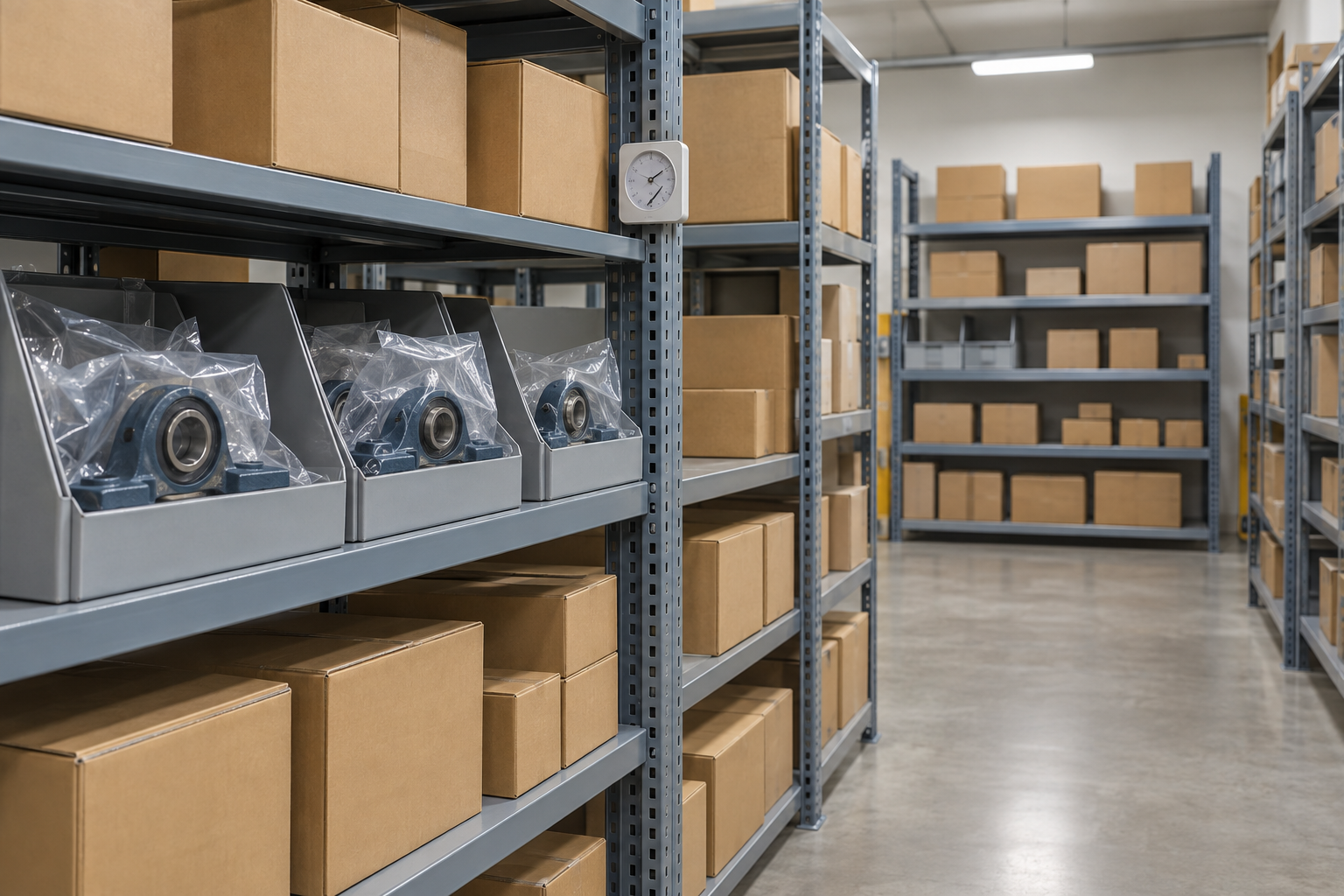
Store bearings on stable, load-rated shelving. Keeping cartons off the floor reduces exposure to condensation, cleaning water, impacts, pests and unnoticed leaks. NSK recommends shelf storage above the floor and warns against unstable stacks or packaging damage.[1] The appropriate height and arrangement still depend on local flood risk, cleaning practice, handling equipment and carton size.
Mounted bearing housings make packages heavier and less uniform than small loose-bearing boxes. Avoid stacks that can collapse or crush lower cartons, and position heavy units where they can be retrieved safely without dropping or dragging them.
Keep Stored Bearings Away from Vibration
Continuous vibration from presses, crushers, vibrating screens, compressors, traffic or nearby machinery can pass through a building and storage rack. SKF advises vibration-free storage because vibration can damage raceways while a bearing is stationary.[2]
Locate bearing stock away from persistent vibration sources. If vibration cannot be avoided, obtain site-specific advice about rack isolation, storage duration and inspection.
Use FIFO and Maintain Traceability
A first-in, first-out inventory policy reduces the chance that older units remain hidden behind new deliveries. SKF also recommends FIFO for stored bearings.[2] It works best when each package can be traced.
| Record | Why it matters |
|---|---|
| Supplier, purchase order and receiving date | Connects the physical stock to purchasing records |
| Complete unit designation and quantity | Reduces selection errors between similar units |
| Package or production date when supplied | Supports product-specific shelf-life review |
| Lot or batch reference when supplied | Preserves traceability |
| Packaging condition at receipt | Documents damage before storage |
| Storage location and environmental exception | Identifies stock exposed to a questionable condition |
| Opening, inspection or disposition date | Prevents uncertain packages returning to normal stock |
Do not invent a manufacturing date from the receiving date. They serve different purposes.
Receiving Inspection for Mounted Bearing Units
Check the shipment before opening
Check cartons and pallets for crushing, punctures, wet areas, broken seals, corrosion stains or evidence of impact. Compare labels and quantities with the purchase documents while keeping the protective packaging closed. Photograph visible damage and separate affected packages from accepted stock.
Verify the product identification
Confirm the complete unit designation, bore size, housing style, locking method and any specified seal, cover, grease or material option. Similar UCP, UCF, UCFL and UCT packages can contain units with different shaft sizes or configurations. The bearing model number guide can help staff interpret common designations, but the order confirmation and product documentation remain the controlling references.
Avoid unnecessary rotation or cleaning
Do not spin a new bearing with compressed air. Do not wash away the factory preservative or grease unless the product instructions specifically require preparation before installation. Timken advises keeping bearings packaged until installation and cautions against removing the supplied protection without need.[3]
What to Do Before Installation
Let the closed package reach the installation-area temperature
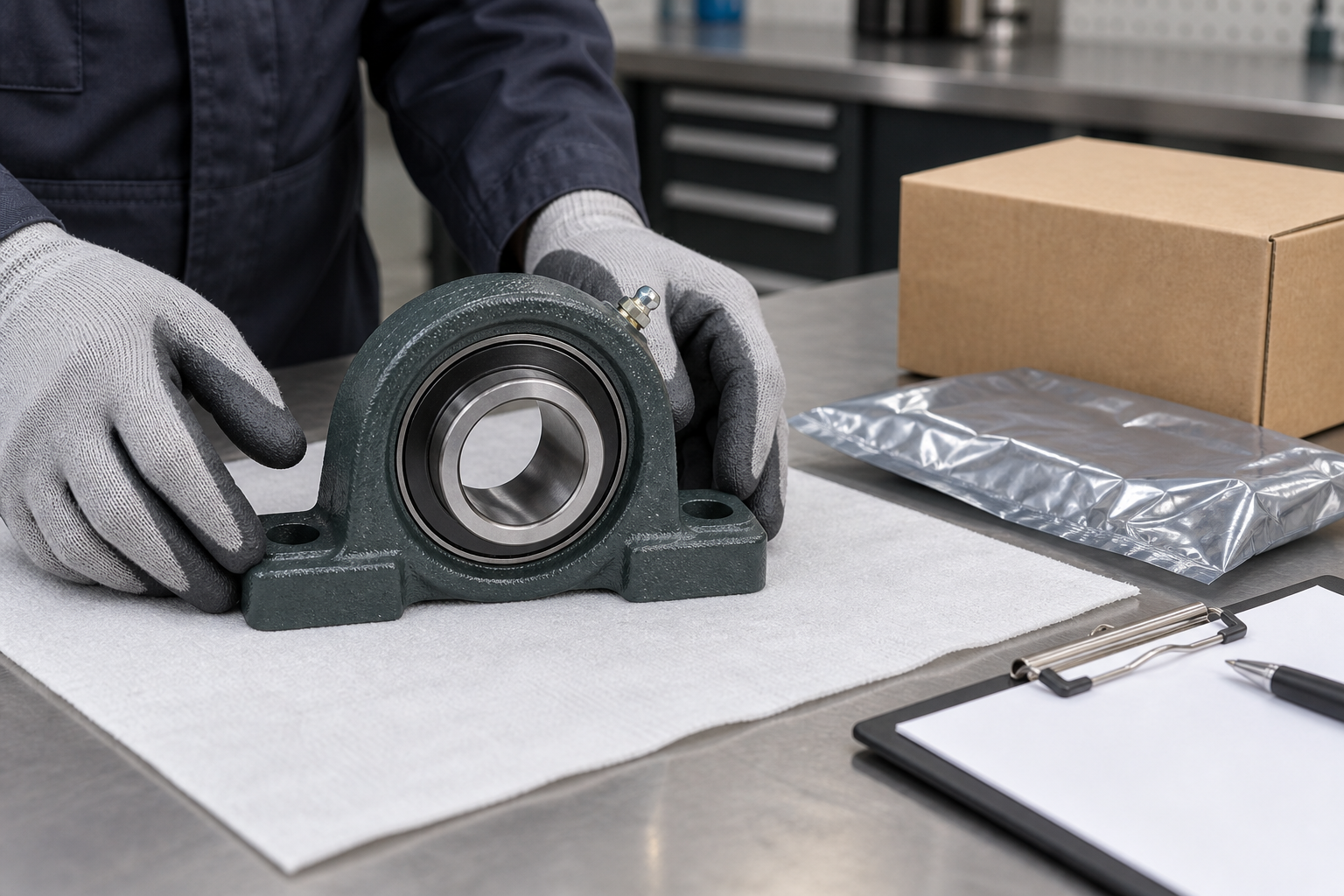
If the bearing was stored in a cooler area, let the closed package approach the installation-area temperature before opening it. This reduces the risk of condensation forming on a cold unit in warmer, humid air.
Open it only when the work area is ready
Prepare the shaft, mounting surface, tools, fasteners and clean work area first. Then open the package as close as practical to installation time. Wear clean gloves and avoid touching seals or finished surfaces unnecessarily. Continue with the insert bearing installation guide only after the product and work area are ready.
Perform a focused visual check
| Check | What to confirm |
|---|---|
| Identification | The unit designation matches the job |
| Housing | Mounting feet and body show no impact damage |
| Bearing and seals | Rotation and seal condition match manufacturer handling guidance |
| Fittings and locking parts | Required components are present and undamaged |
| Condition | No visible corrosion, contamination or abnormal grease leakage |
| Interfaces | The bore, shaft and mounting surface are clean and compatible |
| Records | No unresolved packaging or storage exception remains |
Special Considerations for Long-Term and Seasonal Spares
Agricultural equipment, harvest machinery and seasonal processing lines may keep spare mounted units for extended periods. Shelf life is not the same as operating life: a stored unit has no running hours, but its lubricant, seals, preservative and packaging can still age.
For long-term stock, confirm product-specific shelf-life guidance, review grease and seal limitations for prelubricated units, maintain environmental records and avoid opening packages simply to exercise the bearing. Obtain supplier guidance before using stock with uncertain history.
What If the Packaging Is Wet or Damaged?
Do not place the package directly into available stock and do not hide the damage with new outer tape. Quarantine it, record what was observed and determine whether the inner moisture barrier and product were affected.
If the unit has visible rust, contamination, seal damage, water exposure or questionable grease condition, request a technical disposition. The guide to preventing contamination in mounted bearing units explains why particles and moisture should be controlled. For corrosion investigation, also see causes of rust on bearing inner rings.
A Practical Storage Checklist
| Step | Storage control |
|---|---|
| 1 | Keep original packaging sealed and undamaged |
| 2 | Store indoors in a clean, dry area with stable temperature |
| 3 | Monitor humidity and conditions that can cause condensation |
| 4 | Separate stock from water, chemicals, fumes, dust and direct sunlight |
| 5 | Use load-rated shelving and keep packages safely above the floor |
| 6 | Avoid crushing, dropping, vibration and unstable stacking |
| 7 | Record model, quantity, receiving date and package condition |
| 8 | Rotate stock using FIFO where appropriate |
| 9 | Quarantine wet, opened, damaged or unidentified packages |
| 10 | Open a package only when the clean installation area is ready |
| 11 | Verify the unit and inspect it before mounting |
| 12 | Ask about long-term or uncertain storage instead of guessing |
Information to Provide When Requesting Storage Guidance
Provide the full unit designation, quantity, packaging type, available package or production date, receiving date, intended installation date, actual temperature and humidity history, package status, photographs of any concern, and the planned operating environment.
Cixi CTZ can review packaging and mounted-bearing requirements when the exact unit and storage conditions are known. See Packaging & OEM or contact Cixi CTZ at ctz@ctz-bearing.com. WeChat: DM161116.
Conclusion
Good mounted bearing storage is built around preservation, not repeated handling. Keep unused units in intact original packaging, use a clean and stable indoor environment, control moisture and temperature changes, protect cartons from vibration and impact, and maintain traceable inventory rotation.
Before installation, let the closed package adapt to the work environment, prepare a clean mounting area and perform a focused identification and condition check. When storage history or packaging condition is uncertain, obtain product-specific guidance instead of relying on a universal shelf-life assumption.
Technical references
[1] NSK, Bearing Handling — Bearing Storage. Used to verify guidance on low-humidity, stable-temperature storage, shelving above the floor, safe handling and packaging protection.
[2] SKF, Storage guidance. Used to verify original-packaging, condensation, vibration and FIFO recommendations. SKF-specific limits are not presented as Cixi CTZ specifications.
[3] Timken, Engineering Manual — Bearing Packaging and Storage. Used to verify general original-packaging, clean and dry storage, floor separation, condensation and pre-installation handling principles. Timken shelf-life statements are not transferred to Cixi CTZ products.
Key Takeaways
- Keep unused mounted bearing units in intact original packaging until a clean installation area is ready.
- Use a clean, dry, stable and vibration-free storage environment with safe shelving and traceable stock rotation.
- Quarantine damaged or wet packaging and request product-specific guidance when storage history or shelf life is uncertain.
Frequently Asked Questions
Should mounted bearing units stay in their original packaging?
Yes, unless inspection or installation requires opening. Original, unopened and undamaged packaging helps preserve the manufacturer’s corrosion protection and reduces exposure to moisture and contamination.
Can pillow block bearings be stored directly on a concrete floor?
They should be stored on suitable shelving instead of directly on the floor. Floor-level stock is more exposed to condensation, cleaning water, leaks, impact and packaging damage.
How long can a prelubricated mounted bearing be stored?
There is no single storage period for every unit. It depends on the grease, seals, preservative, packaging, manufacturing date and actual storage environment. Use the product manufacturer’s shelf-life guidance.
Should I rotate a stored bearing periodically?
Do not open and rotate packaged bearings unless the manufacturer or a site-specific preservation procedure requires it. Opening and unnecessary handling may introduce contamination or compromise protection.
What should I do if a bearing package becomes wet?
Quarantine the package, record its condition and determine whether the inner moisture barrier and product were affected. Do not return it to normal stock or install it without an appropriate technical disposition.
Should a cold bearing package be opened in a warm workshop?
Let the closed package approach the workshop temperature first. Opening a cold package in warmer humid air can encourage condensation on metal surfaces.
Need bearing units for your market?
Send us the model number, quantity, packing requirement and destination port. Our sales team will reply with a competitive quotation and delivery schedule.
Send Inquiry